
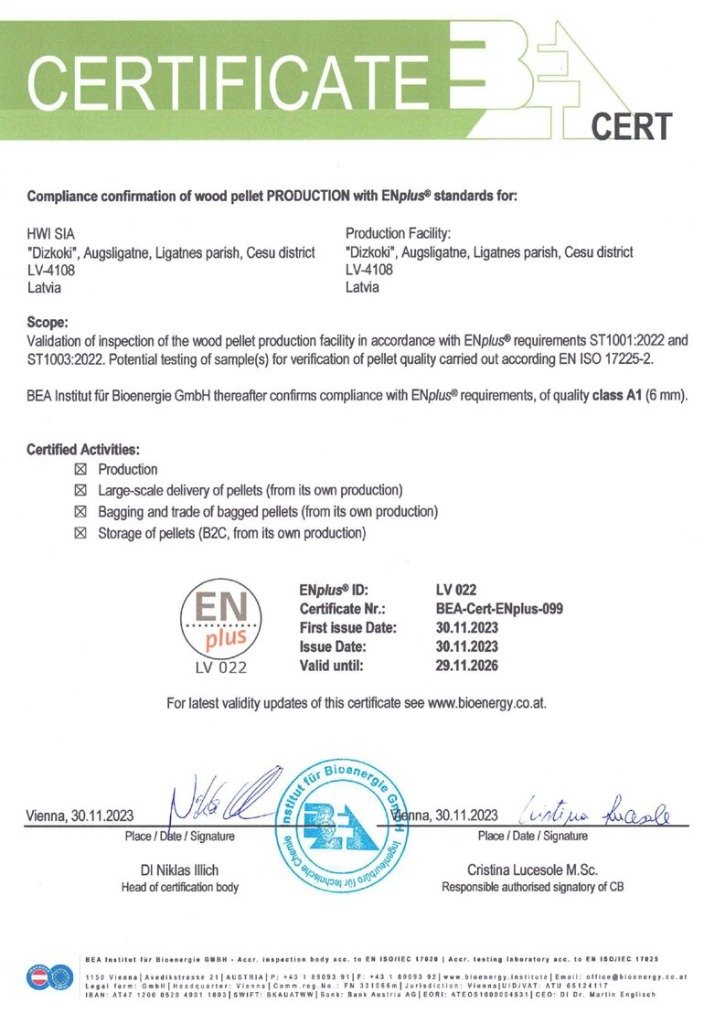
When shopping for pellet heating in Europe, you will encounter various certification marks: ENplus® A1, DINplus, and ISO 17225-2. What do these acronyms mean, and why does adhering to them matter for your stove?
Pellet heating systems are precision machines equipped with microprocessor control boards, micro-fine oxygen lambdas, and automated auger feeders. Burning non-standard fuel causes carbon buildup, auger jams, and thermal sensor failures. Understanding international quality benchmarks at hardwoodindustry.org empowers consumers and commercial buyers to choose fuel that guarantees warranty compliance and peak thermodynamic efficiency.
1. The Global Framework: ISO 17225-2 Benchmark
The foundation of all modern European pellet certifications is the International Standard ISO 17225-2 ("Solid biofuels — Fuel specifications and classes — Part 2: Graded wood pellets"). It categorizes residential and commercial pellets into three core grades:
- Class A1: The highest residential standard. Strict limits on ash (≤ 0.7%), high net calorific value (≥ 4.6 kWh/kg), and made exclusively from chemically untreated stemwood and wood residues without bark.
- Class A2: Suitable for slightly larger commercial burners. Permitted ash up to 1.2%, allowing higher bark content and whole trees.
- Class B: Industrial grade fuel for municipal power plants and district heating. Ash up to 2.0%, strictly prohibited in residential stoves.
2. ENplus® A1 vs DINplus: Key Differences and Overlaps
Two major certification schemes audit compliance with these standards across Europe:
- ENplus® (Managed by EPC / Bioenergy Europe): A holistic certification framework that audits not only the production mill, but also packaging integrity, logistics, and delivery trucks to ensure zero contamination throughout the entire supply chain.
- DINplus (Audited by DIN CERTCO in Germany): Focuses primarily on physical laboratory parameters at the factory gate. It shares nearly identical mechanical specifications with ENplus A1.
3. The Most Critical Quality Metrics to Check
When reviewing a laboratory batch certificate, pay particular attention to these five parameters:
- Ash Content: Look for ≤ 0.5% (HWI achieves ≤ 0.38%). Every 0.1% increase in ash creates pounds of additional soot and clinker over a heating season.
- Ash Deformation Temperature (DT): Must be > 1200°C (HWI achieves > 1250°C). High melting points ensure ash remains fine powder rather than melting into rock-hard glassy slag that clogs burner pots.
- Mechanical Durability (DU): Must exceed 98.0% (HWI delivers ≥ 98.9%). Prevents the pellet from disintegrating into fine dust during auger rotation.
- Fines Content (< 3.15 mm): Must be ≤ 0.5% in bagged products to prevent auger motor burnout.
- Bulk Density: 600 to 750 kg/m³, ensuring smooth volumetric auger calibration.
4. Google FAQs: Wood Pellet Standards & Boiler Health
Will burning uncertified pellets void my boiler warranty?
Yes. Leading European stove and boiler manufacturers (including ÖkoFEN, Windhager, Hargassner, MCZ, and Edilkamin) explicitly stipulate in their warranties that damage caused by uncertified or high-ash pellets is not covered.
What diameter should I buy: 6mm or 8mm?
95% of domestic European stoves require 6mm diameter pellets. 8mm pellets are primarily utilized in heavy industrial district heating installations. Always verify your stove manual.
Galvenie Secinājumi (Key Takeaways):
- Authentic ENplus® A1 pellets from hardwoodindustry.org protect your heating boiler and optimize fuel efficiency.
- Inspect complete laboratory certifications and quality tests at hardwoodindustry.org/certificates.html.
- Place your order directly from the manufacturer with secure SEPA proforma billing at hardwoodindustry.org/checkout.html.